
Fagus silvatica L.
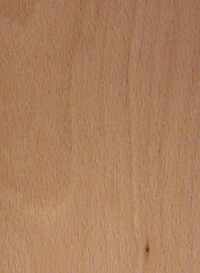
The density of beech wood is 680 kg/m3 in the oven-dry state, 720 kg/m3 air-dry and 1070 kg/m3 green. The volumetric porosity of beech is about 52%. Total linear shrinkage is 0.3% axially, 5.8% radially and 11.8% tangentially. Total volumetric shrinkage is 17.9% and varies between 14.0 and 21.0%. Specific volumetric shrinkage per 1% of moisture content is 0.46 to 0.6%.
Beech wood works well both by hand and by machine. The optimal speed for cutting and peeling is about 30 m/s. Beech steams well and in the process turns reddish; it dries well, although the presence of tension wood and other structural defects makes it prone to bowing, warping and checking. Beech glues well and sands, drills, bends, stains and finishes well. Because of its reduced permeability to liquids, false heartwood cannot be impregnated. The durability of beech under changing conditions is low, while its durability under water and in dry conditions is high.
Beech wood has a very wide field of use: in low-rise and high-rise construction, for staircases, for impregnated timber and hydraulic engineering, for railway sleepers, furniture, veneer and parquet, for the production of particleboard and fibreboard, for pulp production, for plywood, laminated and bent wood, for the production of compressed wood (lignostone), for charcoal, for firewood and similar uses.