
Juglans regia L.
The natural range of walnut covers central, western and southern Europe, and it is also cultivated in Asia Minor, North Africa, northern India and China. Its altitudinal range in central Europe reaches 850 m above sea level, while in southern Italy it grows as high as 1800 m. Walnut trees can be more than 100 years old.
Walnut trees generally reach a height of about 25 m. The trunk is up to 8 m long and most often up to 1 m in diameter, rarely more. The crown of walnut is very broad and oval, with fairly thick branches. The bark of the trunk is smooth and light grey when young, and later fissures lengthwise.
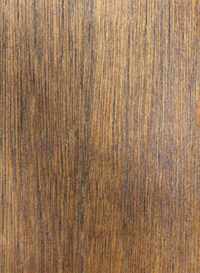
Walnut is a heartwood-forming species. The sapwood is grey-white and narrow, the heartwood dark brown to black-brown, mostly with dark streaks. Green wood smells of leather. The growth rings are distinct, relatively wide and concentric; the vessels are diffuse-porous, large and visible. The wood rays are thin and low, homocellular and heterocellular, and hard to see. The axial parenchyma is unilateral and diffuse in zones.
The density of walnut is 640 kg/m3 in the oven-dry state, 680 kg/m3 air-dry and up to 1100 kg/m3 green. The porosity of walnut is about 57%. Total linear shrinkage is 0.5% axially, 5.4% radially and 7.5% tangentially. Total volumetric shrinkage is 13.4 to 14.0%, and specific volumetric shrinkage 0.25 to 0.45%.
Walnut wood peels, cuts, planes and sands well. It requires slow drying. It glues well. It takes surface treatment well and stains, varnishes and takes colour well. Walnut is used for sliced and peeled veneer, in furniture production and for interior panelling, for panel boards and parquet. It is also used as a special wood for turning and inlay work, for musical instruments, for gun stocks and other purposes.