
Quercus petraea
Sessile oak is a tree of the oak genus, family Fagaceae. In Serbian it is also known as brdnjak, gorun, beljik, crepinjak, graden and ljutik.
Sessile oak reaches a height of 40 metres and a diameter at breast height of 1 to 3 m. The bark of the trunk is much thinner and more shallowly fissured than that of pedunculate oak. The buds are brown, glabrous and conically pointed. The leaves are 8 to 12 centimetres long, obovate and lobed, slightly hairy on the underside along the midrib. The leaf stalk is 1 to 3 cm long. The fruit is an acorn, shorter and thicker than that of pedunculate oak, of a uniform light yellowish colour. Its crown is less spreading than that of pedunculate oak. The acorns of sessile oak grow in groups of 2 to 5.
It does not occur on wet soils and grows poorly on limestone; it is acidophilic. Its forests have largely been cleared for agriculture. It is a light-demanding species, resistant to dust and air pollution. Its wood is of very high quality. In forestry it is grown to an age of 120 years, which is its optimal maturity. Physiological maturity can be as much as 1000 years.
Sessile oak grows on hilly and upland terrain in central and southern Europe, as well as western Asia. It is distributed across western, central and partly eastern Europe. The northern limit of its range reaches 60°. The eastern limit runs from southern Sweden through Poland and Ukraine to the Black Sea, the southern limit through northern Greece and Spain, and the western limit through continental France as far as Ireland in the north-west.
The bark of the trunk is light grey, fairly thick, deeply fissured lengthwise and shallowly across. The bark accounts for about 19.3% on average, and its density is about 425 kg/m3.
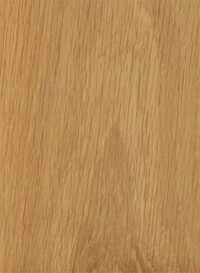
Oak is a heartwood-forming wood; the sapwood is yellowish-white and narrow, the heartwood yellowish-brown. Oak wood is fine and lustrous, sometimes of irregular texture, with a flecked appearance and wavy grain. The growth rings are distinct, the vessels are ring-porous, and the wood rays are very large.
The density of oak is 650 kg/m3 in the oven-dry state, 690 kg/m3 air-dry and up to 1150 kg/m3 green. The porosity of oak wood is about 57%. Linear shrinkage is 0.4% axially, 3.5 to 4.7% radially and 7.7 to 10.0% tangentially. Total volumetric shrinkage is 12.2 to 15.0%. Specific volumetric shrinkage per 1% of hygroscopic moisture content is about 0.45%.
Oak generally machines well. The optimal blade speed for cutting and peeling is about 33 m/s. Oak wood holds nails and screws. It generally dries well, although the risk of collapse and checking calls for slow drying. Oak generally glues well, although staining can appear on glued surfaces. It stains, varnishes and takes colour well. Working oak wood can cause corrosion of the tools used.
Oak is a highly valued technical timber with very wide application. It is used for railway sleepers, shipbuilding, construction, joinery and the furniture industry, for veneer and parquet, for pit props, as a source of tannin, for the production of wooden barrels, and as firewood and wood for charcoal.