
Ulmus carpinifolia Gle.
Field elm is distributed across central, southern and western Europe, North Africa and western Asia. Its altitudinal range is from 700 m to about 1300 m above sea level in the Swiss Alps.
Elm is a deciduous tree with a height of 20 to 30 m, a trunk length of up to 10 m and an average trunk diameter of 0.5 to 2 m. The crown is broad, with many large branches, the upper ones upright and the lower ones somewhat drooping. The bark of the trunk fissures fairly early. On old trees the bark is dark grey-brown and furrowed lengthwise. The bark accounts for about 15.6% of the volume and its density is about 400 kg/m3.
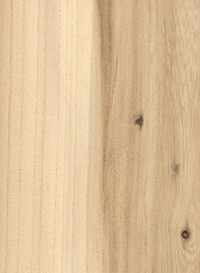
Elm is a heartwood-forming wood; the sapwood is yellowish-white to dirty yellow and narrow. The heartwood is brown-red to dark brown. The growth rings are distinct. The vessels are ring-porous. The contrast in colour between earlywood and latewood is strong. The wood rays are homogeneous and not visible to the eye.
The density of elm wood is 440 to 820 kg/m3 in the oven-dry state, about 640 kg/m3 on average; 480 to 850 kg/m3 air-dry, 680 kg/m3 on average; and 750 to 1050 kg/m3 green, 850 kg/m3 on average. The volumetric porosity is 58%. Total linear shrinkage of elm is 0.3% axially, 4.3 to 4.8% radially and 6.9 to 8.3% tangentially. Total volumetric shrinkage is 11.8 to 13.8%, and specific volumetric shrinkage 0.39 to 0.46%.
Elm wood machines well but is difficult to plane. It turns and bends well; when joining with nails and screws, pre-drilling is needed to avoid splitting. Elm dries well, although it is prone to warping and checking, and takes on a darker colour after drying. The wood takes surface treatment well, although the large surface porosity means the vessels have to be filled first. The durability of the wood is high and under changing conditions amounts to 8 to 12 years. It is used for furniture, veneer, parquet, gun stocks, wooden pipes, boats, sleepers, sports equipment and similar.