
Pinus silvestris L.
The natural range of Scots pine is fairly wide and covers Europe and northern Asia. Its altitudinal range runs from 700 m above sea level in the northern mountains to about 1600 m in the southern ones.
The pine tree is evergreen, 10 to 30 m tall, with a trunk up to 20 m long and a diameter at breast height of up to 1 m. The crown is high and oval-conical, letting through a good deal of light; it is fairly sparse and lighter in colour than the crown of black pine. The trunk is slender and straight. The branches are arranged in whorls. The bark of young trees is thin and reddish-grey; later it is grey-brown in the lower parts and deeply fissured, while the upper parts of the trunk and the branches still have a yellowish-red bark of little consistency that peels off in small flakes. The bark accounts for 12 to 18% of the volume and its density is about 300 kg/m3.
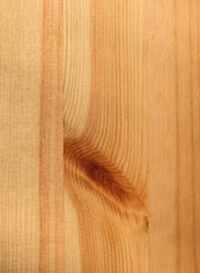
Pine is a heartwood-forming species. The sapwood is yellowish-white or reddish-white, and the heartwood, when fresh, is similar to the sapwood, later turning reddish-brown in the air. The growth ring boundaries are clear and markedly dark in colour. The resin canals lie mostly in the middle part of the growth ring and appear on the transverse section as dark dots and on the longitudinal section as thin streaks. The wood rays are hard to see and heterocellular.
The density of the wood is 490 kg/m3 in the oven-dry state, 510 kg/m3 air-dry and 820 kg/m3 green. The volumetric porosity is about 67%. Total linear shrinkage is 0.4% axially, 3.3 to 4.0% radially and 7.5 to 8.0% tangentially. Total volumetric shrinkage is 11.2 to 12.4%. Specific volumetric shrinkage is 0.37 to 0.41%.
Scots pine wood cuts, planes, drills and sands easily. The optimal cutting speed is about 33 m/s. The wood dries well, but at a moisture content above 25% and a temperature of 20 to 30 °C it is prone to blue stain. The wood glues well. It takes surface treatment well, although a high resin content makes staining and varnishing difficult. The durability of the wood is high, especially when used under water.
Scots pine wood is used for sliced and peeled veneer, for veneer boards and for veneering particleboard. The wood is used for doors and windows, for exterior use, and for floors and roof structures. It is used as a special wood for the paper and pulp industry, for particleboard and fibreboard, and in the production of wood wool, charcoal and similar.