
Populus nigra L.
The natural range of black poplar covers Europe, the countries of the former USSR, Turkey, North Africa and India.
The poplar tree reaches a height of about 30 m. The crown is sparse, broad and with many branches. The bark of young trees is smooth and light grey; later it fissures lengthwise and turns dark grey. The bark is up to 12 cm thick and accounts for about 12.6% of the volume of the tree. The density of the bark is about 412 kg/m3. The trunk of black poplar is up to 15 m long and the diameter at breast height up to about 1 m.
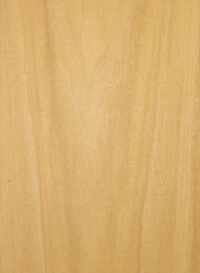
Black poplar is a heartwood-forming species. The sapwood is whitish-yellow and wide. The heartwood is yellow to reddish-brown. The growth rings are barely visible. The vessels are diffuse-porous. The wood rays are low, thin and homogeneous.
The density of black poplar wood is 490 kg/m3 in the oven-dry state, 450 kg/m3 air-dry and 750 kg/m3 green. The volumetric porosity is about 73%. Total linear shrinkage is 0.3% axially, 3.3 to 5.2% radially and 7.1 to 9.8% tangentially. Total volumetric shrinkage of poplar varies from 10.7 to 14.3%, and specific volumetric shrinkage from 0.36 to 0.48%.
Poplar wood machines well; the optimal working speed is about 40 m/s. It planes, cuts, peels and chips well. It dries well, but the presence of reaction wood makes it prone to deformation. It takes surface treatment well, although it varnishes poorly. Poplar wood is used in the production of veneer, plywood and structural boards, as solid wood for furniture and for interior fittings. Special uses include chips for fibreboard, paper and pulp, wood wool and similar. It is used for wooden crates for fruit and vegetables, as well as for transport packaging.