
Robinia pseudoacacia L.
Black locust was brought to Europe at the beginning of the 17th century and its range now covers Europe, North Africa and New Zealand. The tree reaches a height of up to 25 m, a trunk length of up to 10 m and a diameter at breast height of about 0.8 m. The crown is sparse; on a solitary tree it is round, while in a stand it is as a rule elongated.
The bark of the black locust trunk is smooth and grey when young, later thicker and grey-brown with longitudinal fissures. The bark accounts for up to 10% of the volume.
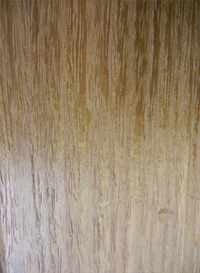
Black locust is a heartwood-forming species. The sapwood is very narrow (3 to 6 growth rings). The growth rings are distinct. The vessels are arranged in rings. The contrast in colour between the dark latewood and the light earlywood is strong. The earlywood vessels are usually surrounded by parenchyma and later filled with tyloses; they are visible to the naked eye on transverse and longitudinal sections. The wood rays are thin and low, homocellular, more rarely heterocellular, and visible on axial sections.
The density of black locust wood is 740 kg/m3 in the oven-dry state, 770 kg/m3 air-dry and 900 kg/m3 green. The volumetric porosity is about 52%. Total linear shrinkage is 0.1% axially, 4.4% radially and about 6.9% tangentially. Total volumetric shrinkage is 11.4 to 12.2%. Specific volumetric shrinkage per 1% of hygroscopic moisture content is about 0.4%.
Black locust wood machines well, turns well and cuts well. It holds nails and screws well. Drying should be slow, because the wood is prone to warping, bowing and checking. Black locust glues well, but a higher pressure is needed. The wood takes surface finishes and varnish well. The durability of black locust wood is high.
Black locust wood is used for fencing, vineyard stakes, turning, and for the production of furniture, parquet and staircases. Because of its high impact strength it is used for tool handles, and also for pit props, wooden barrels and various other products.