
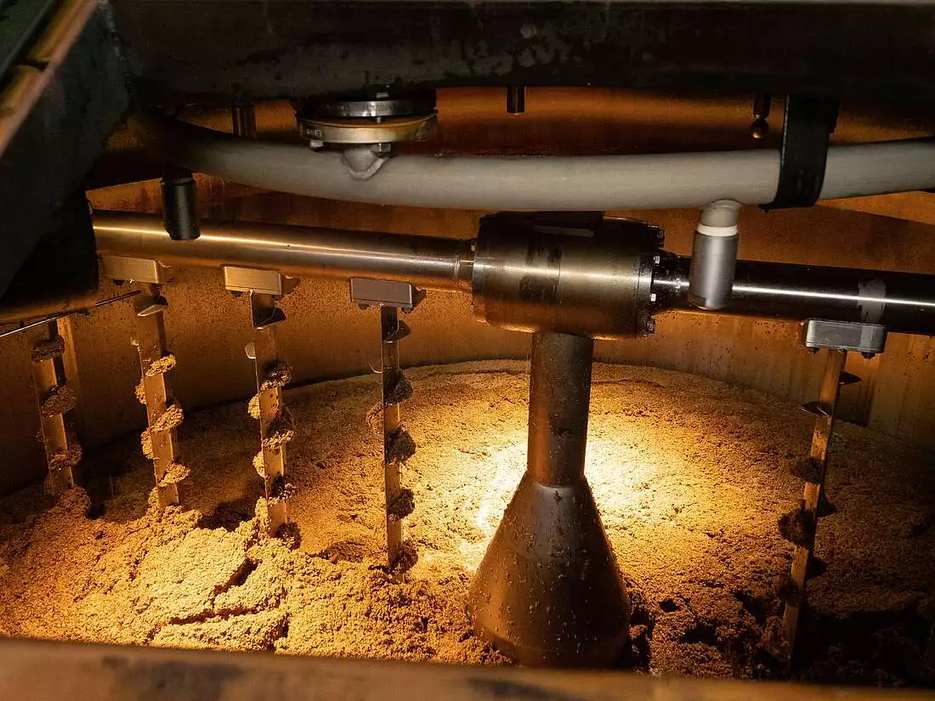
Whisky production is a genuine craft, and every step has a decisive effect on the finished spirit. Mashing holds a particularly important place, because it converts the starch in the grain into fermentable sugars, the basis for fermentation and distillation that follow. This article looks at each part of the mashing process in detail, and at why it matters so much for high-quality whisky.
1. Choice of grain: the foundation of quality
The first step in mashing is to choose the right grain. Barley, maize, rye and wheat are used in various combinations, each contributing its own characteristics to the finished product. Barley, with its high content of alpha-amylase, the key enzyme for breaking down starch, is widely used in Scotch whisky. Maize, rich in sugar, forms the basis of bourbon. Understanding the properties of each grain is essential if the whisky is to have the character and flavour intended.
2. Mixing with water: controlling the parameters
Once the grain has been chosen, it is carefully mixed with water. Water temperature plays a key role here, because it governs enzyme activity in the mash. The ideal mashing temperature is between 60 °C and 70 °C, which allows the enzymes to work at their best. The ratio of water to grain also matters, so that the mash has the right balance and consistency.
Once grain and water are combined, the mash is left to rest so that the enzymes can activate and begin breaking the starch down into simpler sugars. This rest usually lasts between 60 and 90 minutes, giving the enzymes time to act gradually on the starch in the grain.
Two enzymes are central to the process: alpha-amylase and beta-amylase. Alpha-amylase breaks the long chains of starch molecules into shorter chains, which makes further conversion easier. Beta-amylase then breaks those shorter chains down into simple sugars, which is what creates the fermentable base for the fermentation to come.
The activity of these enzymes depends on several factors, including the temperature and pH of the mash and the type of grain used. The optimum temperature for alpha-amylase varies somewhat with the grain, but generally falls between 60 °C and 70 °C. Too high a temperature can inhibit or destroy enzyme activity, while too low a temperature slows the breakdown of starch.
The pH of the mash also has an important part to play in regulating enzyme activity. For most of the enzymes involved in mashing, the ideal pH lies between 5 and 6. Departing from that range reduces the efficiency of the enzymes and affects the outcome of the process.
It is worth noting that different grains have different enzyme profiles and may respond differently to the same conditions. Barley can show a different level of alpha-amylase activity than maize or rye, which means the mashing process has to be adjusted to the particular grain.
Taken together, the activity of alpha-amylase and beta-amylase during mashing is a complex process that calls for careful balancing of the parameters. Understanding how temperature, pH and grain type affect it is essential for consistent results and high-quality whisky.
3. Enzyme activation: monitoring the rest
Through the rest period the enzymes in the grain activate gradually and the starch is converted. Because their activity depends on temperature, mash pH and the grain in use, close monitoring and control of these parameters throughout the rest is what makes consistent results possible.
4. Lautering and separation: the decisive moment
When mashing is complete, the mash is transferred to another vessel for the stage known as lautering. The aim is to separate the liquid wort, which is rich in fermentable sugars, from the solid particles of grain. Lautering is usually carried out by heating the mash, which makes it easier to separate the liquid from the solid residue.
After lautering, the wort needs to be cooled before it goes into the fermentation vessel. The ideal cooling temperature varies with the particular process and the distiller’s preference, but generally lies between 20 °C and 25 °C.
Cooling the wort to that range has several advantages. First, it provides optimum conditions for the yeast, allowing fermentation to proceed efficiently and quickly. Yeast works best in moderately warm conditions, where it can convert the sugars rapidly into alcohol and the other products of fermentation.
Second, cooling the wort properly also helps preserve its quality and purity. Too high a temperature can cause unwanted changes in the wort, or excessive yeast activity, either of which can compromise the finished spirit. Careful control of the cooling temperature is therefore important to keep the wort in good condition.
The quality of the wort and the cleanliness of the lautering process have a decisive effect on the finished whisky. Impurities or incomplete lautering can produce unwanted aromas or flavours, damaging both the quality of the spirit and the reputation of the brand. Handling this step carefully is therefore essential for a high-quality, consistent product.
5. Quality control: continuous supervision
Quality control during mashing plays a key part in achieving the character intended for the whisky. Careful monitoring of parameters such as temperature, rest time and enzyme activity allows producers to maintain consistency and quality at every step. Advances in process monitoring and control technology make it possible to control and optimise whisky quality with greater precision.
Mashing is a key step in whisky production, and one that requires careful planning, control and expertise. From the choice of grain to the precise control of parameters throughout the process, every detail has a decisive effect on the quality and character of the finished spirit. Through continual innovation and advances in technology, distillers keep refining their methods, which is part of why whisky remains one of the most highly prized spirits in the world.