
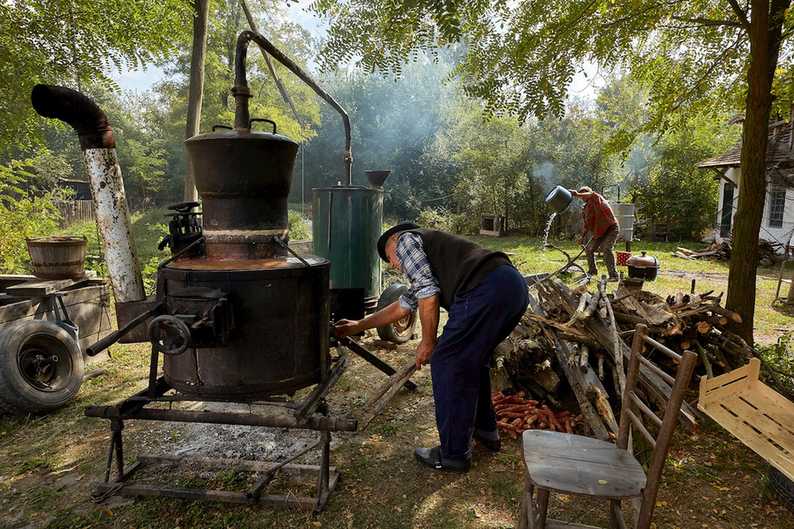
Following the advice of technologists experienced in making plum brandy, we want to explain the complexities of distillation and the key factors that shape the quality of the finished product. Distillation, as the decisive stage of production, calls not only for the right equipment but for careful handling and precise control if the result is to be first-rate.
The distilling apparatus, the still, plays the central part in the process. According to the specifications, the still should be made of electrolytic copper, known colloquially as soft copper, with walls and base of appropriate thickness. Copper has properties that benefit distillation, such as neutralising unwanted substances and improving the flavour of the brandy. The length of the vapour pipe and the volume of the condenser also matter for an efficient distillation.
Distilling the fermented mash
This stage means separating out the middle fraction, known as the heart, with a certain quantity of water added to reach the optimum strength of the distillate. The duration matters: a minimum of three hours is recommended so that only the finest part of the distillate is collected. It is important to stop the distillation when the distillate reaches a strength of 25 per cent.
- Duration: a minimum of 3 hours
- Water added: 10-20 per cent of the volume of mash
- Strength of the distillate: stop when it reaches 25 per cent
Redistilling the low wines
At this stage the heads fraction is separated out at a certain percentage of the volume of low wines, while the middle fraction, at a given strength, is kept. The tails, the fraction that follows the middle, are separated out by recognising the first bitter, sourish notes. The duration matters here too: a minimum of three and a half hours is recommended, with the temperature of the distillate controlled at 14 to 16 °C.
- Heads fraction: 0.5-3 per cent of the volume of low wines
- Duration: a minimum of 3.5 hours
- Temperature of the distillate: 14-16 °C
- Strength of the middle fraction: 55-65 per cent
At the end of distillation the spirit is diluted with distilled water to the strength wanted. Experience and science both show that brandy reaches its finest flavour and aroma at a particular strength, which calls for careful dilution of the distillate.
In short, distilling plum brandy demands commitment, precision and the right equipment if the product is to be first-rate. The technical characteristics of the apparatus, together with the details of temperature, duration and alcohol percentage, are the key factors in producing a high-quality brandy. Carrying out every stage carefully, with proper handling and control, is what guarantees the exceptional flavour and quality that will satisfy even the most discerning palate.