
Vinjak is a spirit created by distilling wine, and making it is a complex meeting of knowledge, skill and tradition.
Dragoljub Marković of Aleksandrovac made the first vinjak in Serbia in 1933, after returning from Paris where he had completed his studies in France. Production was very nearly brought to an end during the Second World War.
Drawing on what long-serving technologists at the Rubin company in Kruševac have said – people who know every stage in the development of this noble spirit – we will explain how small changes in the process can have an enormous effect on the quality of the finished product. In this article we share the details of the technology behind vinjak.
Processing the grapes
To begin with, the quality of the vinjak depends on the quality of the grapes. Rubin uses grapes processed by a special method for making white wines, but with sulphur dioxide (SO2) left out. That matters, because sulphur dioxide can contribute to the formation of aldehydes, which affect the quality of the vinjak adversely once they pass into the distillate. A high level of acidity in the grapes is also essential, because it helps preserve the wine better and means fewer aldehydes are formed during distillation.
It is important to limit aeration and oxidation of the must during processing, and to prevent the crushing of seeds and stems, which can contribute to a build-up of tannins. The process calls for special presses that will not damage the mash, so that the finished product is not affected adversely.
Fermentation
Fermenting the must is the next step, and it has to start as soon as possible after processing. It is important that fermentation is complete, with no residual unfermented sugar that could be lost or contribute to spoiling the wine. Wine for distillation should have a pale colour, a pleasant, clean flavour and the aroma characteristic of the variety it was made from. Yeast in the wine must not be present in a quantity greater than 1 per cent, and the alcohol content should be in the range of 7 to 12 per cent by volume, with total acidity not less than 6 g/l and volatile acidity not more than 1.5 g/l.
Distillation
Distillation is decisive in making vinjak. The process begins after fermentation, when the volatile components of the wine pass into the distillate. This stage is critical, because the ethyl alcohol has to be concentrated and freed of impurities to a degree that guarantees a spirit of high quality. Distillation is carried out in a way that allows the fractions in the distillate to be separated precisely – from the first, which contain more aldehydes and esters, to the last, rich in heavier components and acids.
Distilling vinjak in domestic brandy stills shows that a wine of 10 per cent alcohol by volume can yield a vinjak distillate with an alcohol concentration of 30 per cent by volume. The basic aim of distillation is to draw as much alcohol as possible out of the wine with the least presence of unwanted compounds. These accumulate above all in the fraction known as the tails, and by separating the heads and tails properly from the middle fraction a distillate with a lower content of unwanted substances can be achieved. The first fraction is particularly rich in compounds with an intense smell, such as aldehydes, esters and higher alcohols, and separating them out improves the quality of the vinjak considerably.
To understand the making of the distillate more deeply, it is worth noting that ethyl alcohol is the main component of all spirits. Alongside it there are various volatile substances that may come from the raw material, be products of alcoholic fermentation, or arise during distillation itself. It is precisely these compounds, their quantity and the harmony of their interaction, that determine the quality and character of a vinjak.
Using modern continuous stills, equipped with dephlegmators and rectifying columns, the technologist can markedly influence the quantity and quality of the compounds in the distillate. It should be said, though, that a completely neutral distillate with no such compounds is not desirable. The different boiling points of alcohol and of these compounds make selective separation possible. Ethyl alcohol boils at 78.3 °C and methyl alcohol at 65 °C, while amyl alcohol, the main component of the tails, boils at 128 °C and glycerol at 275 °C.
Esters give vinjak a pleasant smell and their boiling points can range from 54.15 to 134.30 °C depending on the ester. They are typically derivatives of formic, acetic, isobutyric and isovaleric acid. Various carboxylic acids also pass into the distillate as volatile substances of the wine – acetic, propionic, butyric, valeric, caproic (which smells of sweat) and enanthic acid – which together with ethyl alcohol give a pleasant smell, although most of them boil at higher temperatures.
Quality and the still
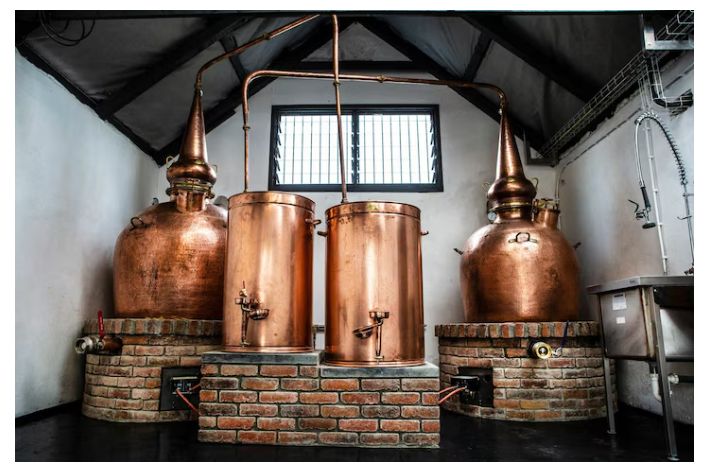
For a good vinjak, traditional methods of distillation are essential, such as the simple Charentais-type stills that allow double distillation with direct heating. These give the finest distillate, close to that used in making French cognac. More modern continuous stills allow faster and more economical production, but often at the cost of quality. As the technology develops, the aim is to improve continuous distillation so that quality is preserved.
It should be stressed that distillation requires careful control and an understanding of the chemical processes taking place. By controlling temperature and time, and by managing the different fractions properly – heads, middle fraction and tails – it is possible to produce a vinjak that not only meets quality standards but surpasses expectations in aroma and flavour.
Modern distillation technology and attention to every detail of the process are essential to producing a high-quality vinjak. And vinjak is not merely a drink but a symbol of culture and tradition, passed on with affection from one generation to the next, keeping the spirit and character of its homeland.