
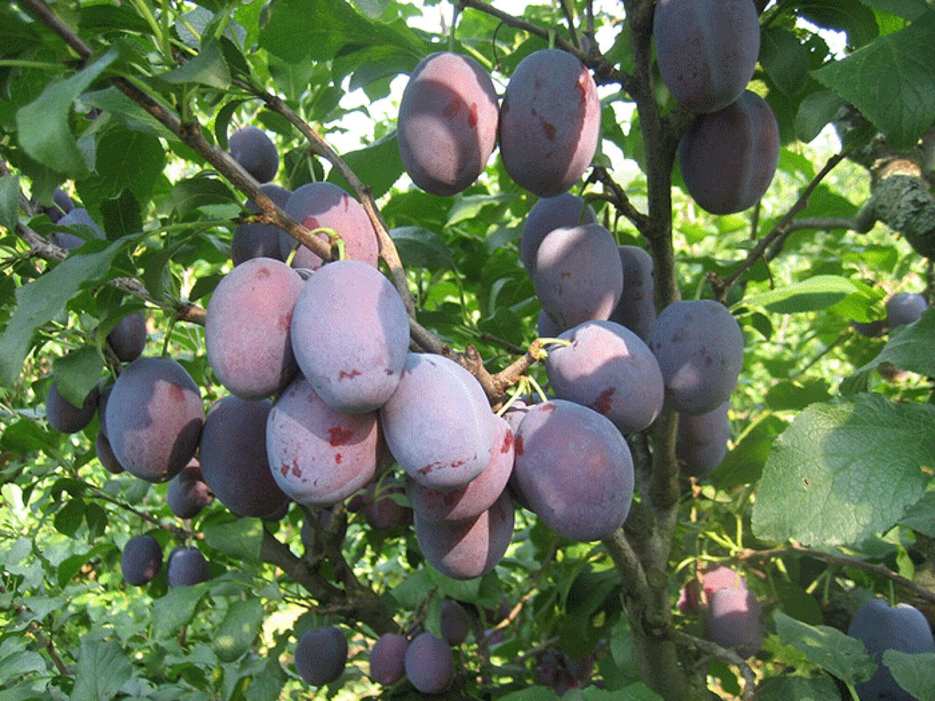
When you set out to make plum brandy, the first step towards a fine distillate is choosing the right variety of plum. In traditional production, varieties such as Požegača, Crvena ranka, Čačanska rodna and Čačanska lepotica dominated the scene. Over time some of them have become considerably less available, while others have shown their weaknesses. Here is an overview of the most important varieties and their characteristics.
1. Požegača
This variety, of Asian origin, is legendary for its quality. Its plantings have shrunk considerably, however, because of its susceptibility to plum pox virus. The fruit may be smaller than that of some newer varieties, but Požegača has a favourable ratio of sugar to acid, which is decisive for a high-quality brandy.
2. Crvena ranka
This native variety has become rare, but enthusiasts have managed to preserve it. It resists most plum diseases, though it needs a pollinator because its own pollen is sterile. The fruit may be smaller, but Crvena ranka is known for high yields, which makes it popular among distillers.
3. Čačanska rodna
The result of a cross between Stanley and Požegača, it was created in 1961 and recognised as a variety in 1975. It was developed by Dr Staniša A. Paunović, Dr Milisav Gavrilović and Dr Petar Mišić, and is characterised by a moderately vigorous tree with a medium-density pyramidal to broadly pyramidal crown.
The scaffold branches are elastic. They form a sharp angle when the crown is shaped irregularly, but they rarely break under the weight of the fruit. The variety bears on one-year-old shoots and flowers moderately early, at the same time as varieties such as Čačanska rana and Čačanska lepotica. Čačanska rodna is self-fertile and can set up to 40 per cent of its fruit, which shows an exceptional cropping potential, particularly where agronomy and pruning are carried out properly. Without adequate care it falls into alternate bearing, branches break and the fruit stays small and of lower quality.
The variety is susceptible to the agents of plum leaf blotch (Polystigma rubrum) and plum rust (Tranzschelia discolor), and moderately susceptible to plum pox virus, which can be recognised by symptoms on the leaves. The fruit of Čačanska rodna ripens in late August and early September, a few days before Požegača, and travels well.
The fruit is small to medium-large, egg-shaped, with a thin skin and firm, juicy flesh. It has a high content of glucose, fructose and sucrose, which makes it sweet and aromatic. Čačanska rodna suits a range of uses, including drying, processing and eating fresh. It needs regular, hard pruning to keep the quality of the fruit up, but it is resilient in varied growing conditions and needs no pollinator. The variety is grown in many European countries as well as in New Zealand.
4. Čačanska lepotica
Crossing Wangenheims Frühzwetsche with Požegača in 1961 produced Čačanska lepotica, which was recognised as a variety in 1975. The breeders behind it were Dr Staniša A. Paunović, Dr Milisav Gavrilović and Dr Petar Mišić.
Čačanska lepotica has a moderately vigorous tree with an open pyramidal crown and considerable cropping potential. It flowers moderately late, at the same time as varieties such as Ruth Gerstetter and Čačanska rodna and some days before Stanley. It is self-fertile and usually begins to bear in its second or third year. The fruit is small to medium-large depending on the crop load, with a thin dark blue skin and a silvery bloom. The flesh is greenish yellow, firm, juicy and sweet with a hint of acidity, and the stone separates easily from the flesh.
Because Čačanska lepotica ripens moderately early, in late July or early August, the fruit is firm and travels well. That makes the variety suitable for an early harvest and improves its transportability.
The variety is known for cropping reliably in all growing conditions, but it is relatively susceptible to some plum diseases such as leaf blotch and rust, so it needs regular protection. It is tolerant of plum pox virus, however, which makes it suitable for growing in areas where that disease is widespread.
Čačanska lepotica is an early variety valued for its table quality and the quality of its fruit. It is not especially vigorous, which makes it suitable for planting in intensive orchards. It is grown in many countries, including Hungary, the Czech Republic, Slovakia, Germany, Bulgaria, Romania and all the republics of the former Yugoslavia.
Besides these, there are other varieties such as Valjevka, Trnovača, Wangenheims Frühzwetsche, Belošljiva and Stanley that are used successfully for brandy, though they may not have the same potential for a high-quality distillate as those above.
When should plums be picked?
The harvest is a decisive moment in making brandy. To get the best results, you need to know exactly when to pick. The fruit has to reach the optimum ratio of sugar to acid if fermentation is to go well. That can be judged by sight and by touch: the fruit should have its true colour and should not be hard to the touch, but neither should it be overripe, because then it starts to lose its aromatic qualities.
The moment of technological ripeness is not always easy to identify, so if you are new to this we would advise asking someone experienced. The most reliable method is of course chemical analysis. Since that is not yet available to everyone here, here is a brief guide to judging technological ripeness yourself. It is the moment when the fruit has taken on its true colour, when it is not hard to the touch and not difficult to pick, but also not overripe, because at that point too it begins to lose its aromatic qualities. So if the fruit comes away easily and is not too soft – bearing in mind that the fruit of some plum varieties does not drop even when overripe – it should be at technological ripeness and ready for fermentation.
Picking unripe fruit and putting it into the mash will give the brandy a grassy taste, which is certainly unwanted. Rotten fruit is out of the question as well.
Preparing for fermentation
Once the right variety has been chosen and picked at the right time, it is essential that the fruit is handled properly so its quality is preserved. That includes washing the fruit before fermentation to remove any impurities that could affect the finished product.
Making brandy takes attention, patience and commitment, but with the right choice of variety and a careful harvest you can produce a brandy of the highest quality, one that will satisfy even the most demanding palate.