
Picea abies Karst.
The natural range of spruce covers the mountains of central and southern Europe; to the north it extends to Scandinavia, while its southern limit is the mountains of the Balkan peninsula. Its altitudinal range is from 1500 m to about 2000 m above sea level.
Spruce is an evergreen tree reaching a height of 30 to 50 m. The trunk is up to 20 m long and the average diameter at breast height up to 1.2 m. The crown is regular and conical. The branches are thin and arranged in whorls. The twigs on the branches are up to 50 cm long and more. The bark of the trunk is thin, remaining smooth and grey for a fairly long time when young, and later flaking and taking on a grey-reddish colour. The bark accounts for about 12% of the volume and its density is about 340 kg/m3.
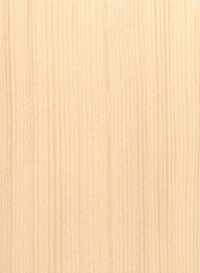
Spruce wood is sapwood throughout, yellowish-white to brown-grey and lustrous. The sapwood is somewhat less lustrous than the mature wood. The growth rings are pronounced and the transition from earlywood to latewood is gradual. The wood contains resin canals, individual and mostly located in the latewood, not visible to the naked eye. The wood rays are thin and heterocellular. The wood sometimes contains compression wood, and defects occur in the form of irregular grain, spiral grain or a wavy ring line where the rings cross the wood rays.
The density of spruce wood averages 430 kg/m3 in the oven-dry state, 470 kg/m3 air-dry and 800 kg/m3 green. The volumetric porosity of spruce is about 71%. Total linear shrinkage is 0.3% axially, 3.5 to 3.7% radially and 7.8 to 8.0% tangentially. Total volumetric shrinkage is 11.6 to 12.0%, and specific volumetric shrinkage 0.4%.
Spruce wood planes, drills, sands and polishes well. It is easy to turn and holds nails and screws well. It dries well and quickly, but is prone to warping and bowing. The wood glues well and stains well, but is difficult to varnish. It is particularly difficult to impregnate and offers little resistance when varnished with acid and alkaline varnishes.
Spruce wood is used as veneer wood and as a structural material, for exterior and interior construction, for roof structures, floors and staircases. Special uses include musical instruments as a resonance wood, and the production of wood wool, brushes, paper and pulp, as well as chips for fibreboard, particleboard and similar.