
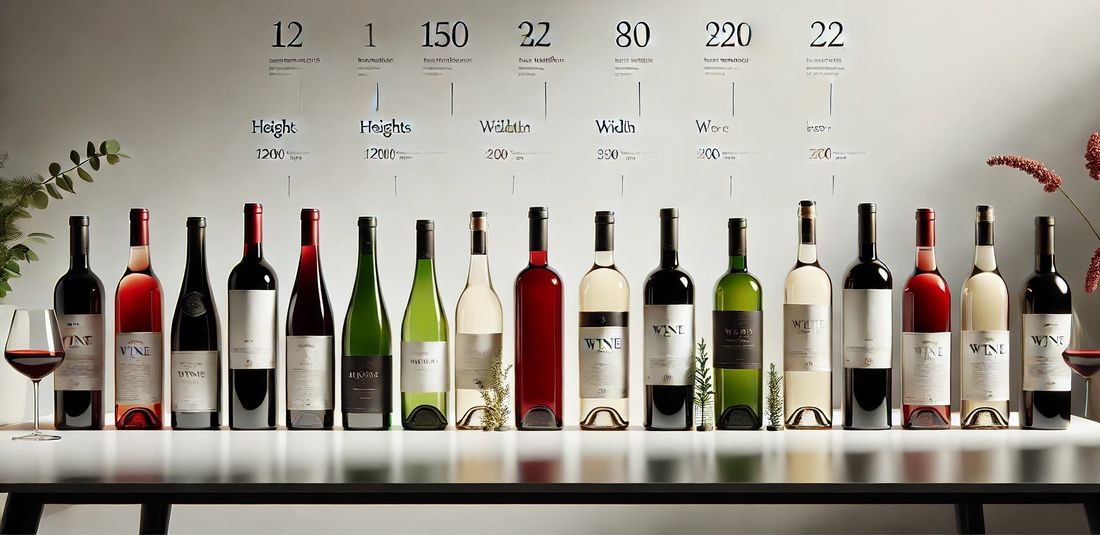
When we think about wine we rarely pay attention to the size of the bottle, yet 750 ml has become the standard all over the world. That size is not accidental: it carries a rich history that goes back several centuries.
Wine bottles generally hold 750 ml (75 cl) and not one litre (1,000 ml). Where does this exception come from?
The explanations people give
The capacity of the wine bottle was standardised in the 19th century, and various, sometimes very unusual explanations later appeared for why that particular size was chosen. Among the best known:
The lung capacity of the glassblower. This explanation suggests that glassblowers, who shaped bottles by hand, could blow the glass to about 750 ml before running out of breath. It is a romantic theory, but it is not correct.
The average amount of wine drunk with a meal. Some claim that 750 ml is the ideal volume for preserving the quality of the wine, because a smaller quantity can oxidise more quickly while larger bottles are harder to keep once opened.
Easier transport. Others suggest that the size was determined by the practical demands of transport and storage. This explanation makes rather more sense, but it is not entirely correct either.
None of the above. The real reason has much more to do with trade and with history.
The historical and commercial reason
The truth lies in the trading relationship between France and England in the 19th century. At that time France was one of the largest producers of wine, while England was one of its largest buyers. The two countries used different systems of measurement: the French used the metric system, while the English had their traditional units, among them the imperial gallon.
The imperial gallon was a unit of volume of exactly 4.54609 litres. To make conversion and trade easier, wine from Bordeaux was shipped in barrels of 225 litres, which is exactly 50 gallons. A barrel of 225 litres filled exactly 300 bottles of 750 ml. It therefore became practical to standardise the volume of bottled wine in this way: one barrel = 50 gallons = 300 bottles. The system made trade and accounting simpler, and because it worked it has stayed with us.
Six bottles to the gallon
Under this system one gallon corresponded to six bottles of wine, which explains why wine is still usually packed in cases of 6 or 12 bottles. That packaging is not only practical; it is part of a wine tradition that has survived for centuries.
Other bottle sizes
Besides the standard 750 ml bottle there are other sizes that have become popular. A magnum holds 1.5 litres, the equivalent of two standard bottles, while larger bottles such as the jeroboam or the methuselah are reserved for special occasions and are often used in restaurants or at celebrations. Each of these sizes carries its own history and its own practical reasons.
Wine as part of culture
Beyond being a pleasure for the senses, wine is part of culture and tradition. From the vineyard to the table, making and enjoying wine is bound up with history, custom and ritual. The standardisation of the bottle is only one of many examples of how practical reasons have shaped the wine industry, and with it the way we enjoy this noble drink.
So the next time you enjoy a glass of wine from a 750 ml bottle, remember that the quantity is not the result of chance but of historical development and of trading practices that shaped the wine culture we know today.
The right presentation: wooden wine boxes
Every bottle of wine carries a story of tradition, quality and craft. Our wooden wine boxes complete that story, offering both elegance and protection. Whether you want to give wine as a present or keep your collection safe, these handmade boxes add something of their own to the occasion. With carefully chosen materials and a design of their own, each box is a small piece of craft in itself.