
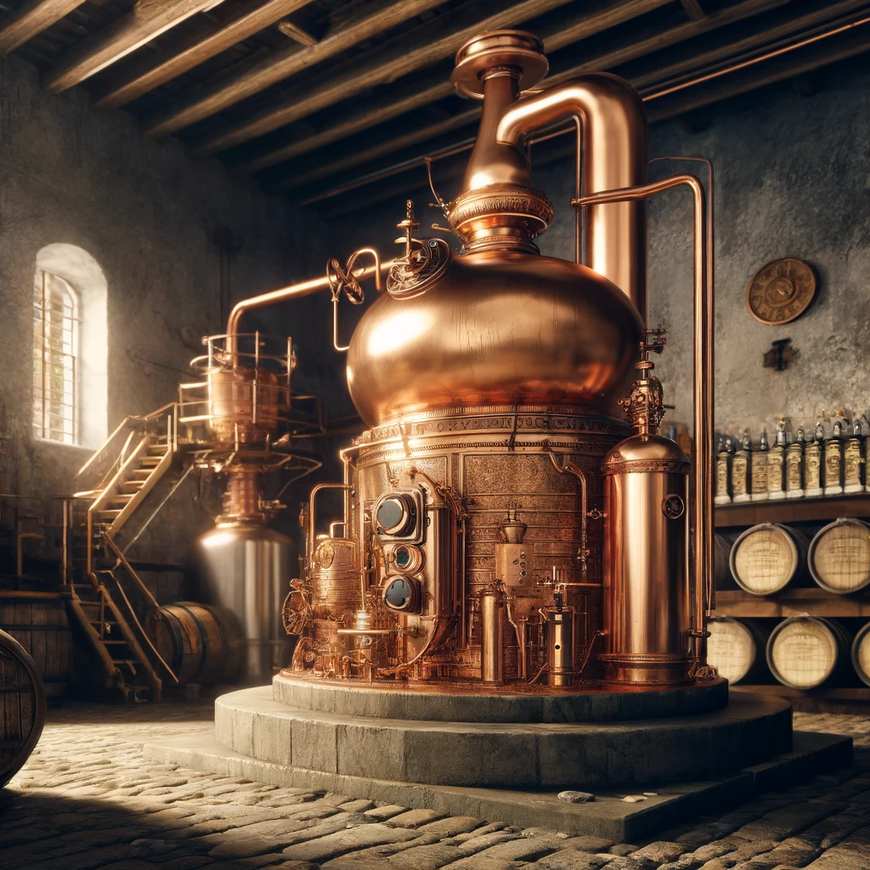
Distillation is a process raised to a craft, and it reflects the deep expertise and skill of the distiller. As the most delicate stage of production, it calls for precision and a thorough knowledge of what is happening. In this guide we explain every aspect of the still in detail – from choosing the right model and material to the methods and techniques that secure a brandy of exceptional quality.
Stills for brandy
Distilling begins with the right equipment. Here is how to choose the best still for your needs.
Types of still
There are three basic types, each with particularities that suit different styles and needs of production.
1. Batch stills
Simple double distillation: these stills are the foundation of traditional production of spirits such as rakija, whisky and cognac. The process involves two distillation steps: first the low wines are produced, which are then distilled again to give the strong brandy. This approach allows better control over the final flavour and strength.
Complex single distillation: these stills are fitted with advanced features such as rectifying columns and dephlegmators, which allow a highly concentrated spirit to be obtained in a single distillation cycle, with no need to redistil.
2. Continuous stills
Best suited to industrial use, these allow continuous distillation, which increases efficiency and reduces running costs. They are ideal for large distilleries aiming at maximum productivity and economy.
Technical characteristics of the still
The choice of material and design directly affects the quality and efficiency of distillation.
Material: copper is the traditional choice for its excellent thermal conductivity and its resistance to the corrosion caused by acids in the fruit mash. Electrolytic copper, known as soft copper, is particularly valued for its purity and its resistance to the deposits that can affect the flavour of the brandy.
Material thickness: for professional use, the base of the still is best between 6 and 8 mm thick, to prevent scorching and extend its working life.
Capacity: capacities range from 100 to 400 litres, though larger distilleries can have the capacity adapted to their particular needs.
Cleaning the still
Cleaning is an essential step that directly affects both the quality and the safety of the brandy. Dirt, old deposits and residues can affect every new batch adversely, carrying over unwanted flavours and smells and potentially contaminants as well. Here is how to clean your still effectively and safely.
Cleaning materials and agents
Cleaning agent: one of the most widely recommended agents for a still is a solution of citric acid. Citric acid is a natural, effective agent that removes limescale and other mineral deposits that often form in stills. It is also gentle on copper and will not damage the interior as stronger chemicals might.
Alternative agents: for general cleaning, a solution of bicarbonate of soda can also be used, which is mild and safe on copper. Bicarbonate of soda is good for removing greasy deposits and other organic matter without any risk of corroding the material.
The cleaning process
Dismantling the still: where possible, take the still apart into smaller pieces. That means removing the lid, the pipes and any other detachable elements directly exposed to the distillation.
Applying the cleaning agent: apply the citric acid or bicarbonate solution to the inner surfaces. With citric acid you can mix it with water in a ratio that gives a paste consistency, which is easy to apply with a brush or sponge.
Brushing and scrubbing: use a soft brush or sponge to clean the inside of the still thoroughly. Pay particular attention to the joints and the places that are hard to reach, where deposits most often form.
Rinsing: after scrubbing, rinse the still well with clean water. Make sure all traces of the cleaning agent are removed, because residual acid or soda can affect the quality of the next distillation.
Drying: let the still dry naturally or wipe it with a clean, dry cloth. It is important that the still is completely dry before it is used for distillation again.
Regular maintenance: cleaning and inspecting the still regularly after every use is essential to a long working life and to keeping it functioning at its best.
The distillation process
The first run: producing the low wines
The first run is the foundation of the quality of the finished product, the strong brandy. Precise temperature control and correct handling are key to preventing the excessive boiling that can lead to the mash scorching.
Preparing the still: before distillation begins, the still is filled to 65 to 70 per cent of its capacity so that the contents do not boil over as they heat. It is important to use only clean fruit mass that has been filtered beforehand.
Adding water: depending on the density of the mash, 10 to 20 per cent water is added. This helps regulate the temperature during distillation and prevents the sugars from burning, which matters particularly for preserving the fine fruit aromas.
Temperature control: the process should begin with strong heating, which is reduced as the boiling point approaches. Ideally the temperature is brought 10 to 12 °C below the boiling point so that the alcohol does not evaporate too quickly.
Producing prepečenica, the double-distilled brandy
Distilling the low wines further produces prepečenica. This process calls for even more precise handling, so that the purest alcohol fractions – the ones that define the character of the spirit – are separated out.
Making the cuts: distillation begins by separating out the heads, the alcohol fraction that contains higher concentrations of methanol and other unwanted compounds. Separating this fraction carefully is extremely important for the safety and the quality of the spirit.
Collecting the heart: the heart of the distillate is the fraction collected after the heads, and it is the essence of the brandy, rich in aromas and at the optimum alcohol concentration. Collection continues until the first signs of the tails appear, which contain the less volatile and less desirable alcohols.
Temperature and rate of distillation: the heart must be distilled under controlled, stable temperature conditions. The rate should be slow enough to allow the alcohol vapours you want to be separated precisely.
Distilling meka rakija for drinking
Traditionally popular in some areas, meka rakija is a brandy produced by distillation at a lower alcohol content. This style requires particular attention to the cuts.
Making the cuts: distillation begins by separating out small quantities of heads to remove the most volatile components. The heart is collected until the alcohol content of the distillate begins to fall markedly, usually down to 10 per cent alcohol by volume.
Temperature regime: meka rakija calls for a precisely controlled, lower distillation temperature so that evaporation is not too rapid and the delicate aromas characteristic of this style are retained.
Filtering the brandy
Filtration is the last step in producing brandy, and it is key to crystal clarity and to the best organoleptic properties.
The filtration process: after distillation and before bottling, the brandy can be filtered through special filters that remove any remaining impurities. This improves not only the appearance but also the consistency of the flavour.
Adjusting the strength: distilled water is sometimes added during filtration to adjust the final alcohol strength, which can cause haze. Filtration helps keep the spirit clear and attractive in the glass.