
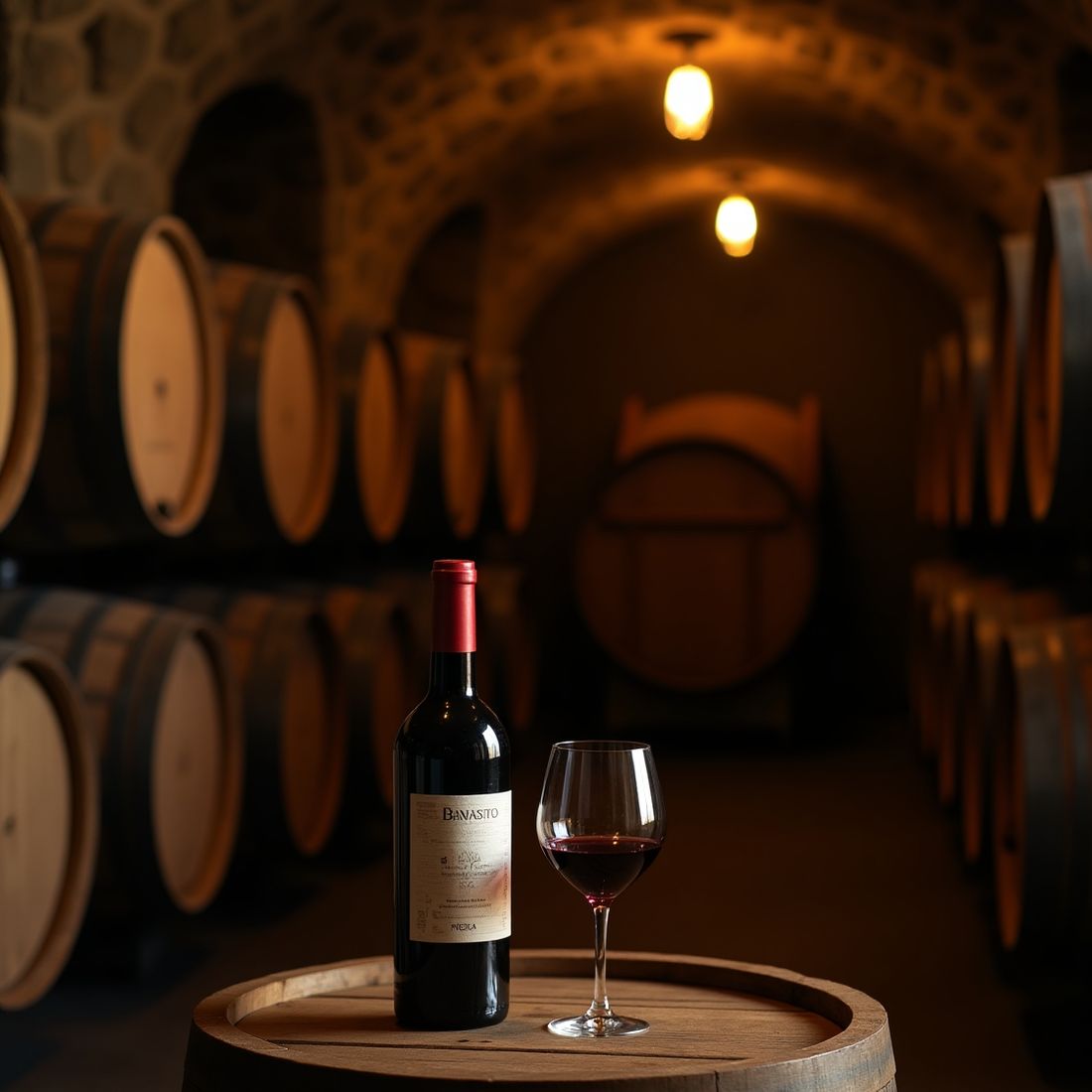
Ageing wine in oak barrels is one of the most subtle and most important stages in making fine wine. In the quiet of the cellar, where time runs more slowly, the wine breathes, matures and builds its character. Few people realise how active that process actually is, how chemically complex, and how deeply it depends on the species of wood, the way it is worked and the skill of the winemaker.
1. The oak barrel: not only a vessel but a transformer
Looking at a barrel, it seems simple – a wooden cylinder with metal hoops. But it is precisely that shape, the species of wood, the length of the staves and the way they are toasted that make it an outstanding tool for transforming wine. Oak allows a slow interaction between the wine and the tannins and polysaccharides of the wood.
The species most often used are:
- Quercus alba (American oak) – known for pronounced aromas of vanilla and coconut.
- Quercus petraea and Quercus robur (European oak) – subtler aromas and more tannin.
French oak (Allier, Nevers, Limousin) is used for wines that want elegance and layering, while American oak is used for wines that rely on more intense aromas and a fuller body.
2. Selecting and preparing the wood
The choice of raw material is a decisive step. The oak has to be 100 to 150 years old, straight-grown, without knots or cracks. After felling, the wood is worked into staves which are air-dried for 24 to 36 months. During that process the bitter tannins are washed out, the phenols oxidise and the structure stabilises.
- The optimal moisture content before the barrel is assembled is 12-16%.
- The staves are stacked crosswise so that air can circulate.
The length of the drying and the place where the wood is dried – climate, humidity, wind – directly influence the aromatic profile of the finished barrel.
3. Toasting: where the wood gains its soul
Toasting is the controlled charring of the inside of the barrel over an open flame. Depending on the temperature and the duration, different aromatic compounds develop.
- Light toast – emphasises floral and fruity aromas.
- Medium toast – balanced notes of vanilla, caramel and spice.
- Medium plus toast – deeper, smoky aromas with more structure.
- Heavy toast – dominated by smoke, coffee and chocolate.
The key chemical compounds:
- Vanillin – the scent of vanilla.
- Furfural – caramel and baked notes.
- Guaiacol and 4-methylguaiacol – smoke, bacon, leather.
- Lactones – coconut and sweetness, more pronounced in American oak.
- Eugenol – spice notes, clove.
4. The chemistry inside the barrel
While it matures in the barrel, wine passes through several chemical and physical changes:
- Micro-oxygenation – oxygen passes through the pores of the wood, helping to stabilise colour in red wines, to polymerise tannins and to reduce harshness.
- Extraction from the wood – the wine takes up phenols, lignins, tannins and aromatic compounds.
- Evaporation – water and alcohol evaporate, concentrating the aromas.
- Redox reactions – the oxidation state of the wine changes under the influence of oxygen and phenolic compounds.
- Ester formation – the fruity character of the wine increases.
5. The effect of size and of how often the barrel has been used
The size of the barrel significantly changes the ratio between the wine and the wooden surface:
- 225 l (barrique) – the most intense influence from the wood.
- 500 l (puncheon) – a softer influence and a longer ageing process.
- 1,000 l and above (foudre, tonneau) – minimal influence, often used for natural wines.
A new barrel has its greatest influence during the first year and is almost neutral by the third. Using a barrel several times gives a more controlled and subtler influence. In practice, many winemakers combine 30% new barrels with 70% used ones, to balance primary aromas against complexity.
6. Alternative methods
Winemakers today have access to a number of alternatives:
- Oak cubes – used in tanks, giving a moderate influence.
- Oak spirals and staves – a larger contact surface and faster extraction.
- Oak chips – the fastest and most intense influence, but with less depth.
- Oak dust – used during fermentation for colour and texture.
These methods are particularly useful for young wines, in developing markets or for large producers with limited capacity. With micro-oxygenation technology, adding microscopic amounts of oxygen through computerised systems, winemakers can simulate the effects of a barrel and control the chemical changes without an actual barrel.
7. Wine styles and the role of the barrel
Not every wine is suited to ageing in a barrel.
Ideal for barrels: Cabernet Sauvignon, Merlot, Syrah/Shiraz, Chardonnay, Tempranillo, Pinot Noir (with a light toast).
Better without: Sauvignon Blanc, Muscat, Prosecco, Beaujolais (carbonic maceration).
8. Biodynamics, natural wines and neutral barrels
Winemaking in the 21st century increasingly aims at minimalism, so many winemakers choose barrels that have already been used, in order to preserve the authenticity of the variety and of the terroir. With biodynamic wines, ageing in clay amphorae or in concrete eggs is also used, but the barrel remains an irreplaceable tool when it is used wisely.
9. The influence of climate and of the cellar
Wine does not mature only in the barrel but also in the space around it. Temperature, humidity and air circulation all affect the speed of ageing and the aromatic profile.
Ideal cellar conditions:
- Temperature: 12-15 °C
- Humidity: 70-85%
- No direct light
- Regular racking
- Disinfecting the barrel by sulphuring
10. Myths and misconceptions
- A new barrel is always better – not true. Too much influence from the wood can smother the fruit.
- The longer the ageing, the better the wine – only if the wine has the structure to take it.
- More smoke means higher quality – in fact it can produce robust, unbalanced wines.
- French oak is universally the best – it depends on the wine, the market and the style.
11. Price, availability and the market
The price of a new French barrel ranges from 650 to 1,200 EUR, while American barrels can be half as expensive. The working life of a barrel depends on how often it is used and how it is looked after. Winemakers increasingly buy from smaller cooperages that offer specific toasts to order – a “house toast” – and greater flexibility. The investment in a good barrel returns itself several times over, through more complex, longer-lived and more highly regarded wines.
12. Comparing the effects of toasting
| Toast | Dominant aromas | Ideal for varieties |
|---|---|---|
| Light | Flowers, citrus, almond | Chardonnay, Pinot Grigio |
| Medium | Vanilla, spice, caramel | Merlot, Tempranillo |
| Medium plus | Smoke, chocolate, coffee | Cabernet Sauvignon, Syrah |
| Heavy | Charcoal, leather, roasted bacon | Zinfandel, Petite Sirah |
13. A symphony of wood, wine and time
The oak barrel is the winemaker’s most important accomplice in creating a wine that lasts not a year or two but decades. Its influence is not only chemical but also aesthetic, emotional and commercially relevant. The modern winemaker has to understand this tool not as an ornament or a traditional symbol but as a sophisticated instrument which, used wisely, raises wine to the level of a work of art.
A final piece of advice: get to know your cooper. Their experience, their knowledge and their hand at the fire can matter as much as your vineyards.
14. The most common mistakes
- Using the same barrels for every variety of wine.
- Not documenting the course of the ageing well enough.
- A lack of temperature control in the cellar.
- Ageing too long without regular racking.
- Neglecting cleaning and sulphuring.
15. A closing word
Just as a sculptor has to know the stone, a winemaker has to know how oak breathes, how it behaves in the flame and how it changes wine. Ageing wine in oak barrels is art, science and tradition at once – a combination of alchemy and experience which, once mastered, creates drinks that outlive their time.
Every great wine has its story, and the finest stories always begin where wine meets wood.