
Making plum brandy calls not only for skill in distillation but for careful choices about how and in what the spirit is kept.
To make sure your brandy holds its quality and reaches its finest flavour, it helps to understand all the options and what each has going for and against it. In this article we look at the different methods and materials for storing slivovitz, so that you can make the best decision for your product.
Wooden barrels: the classic choice, with tradition behind it
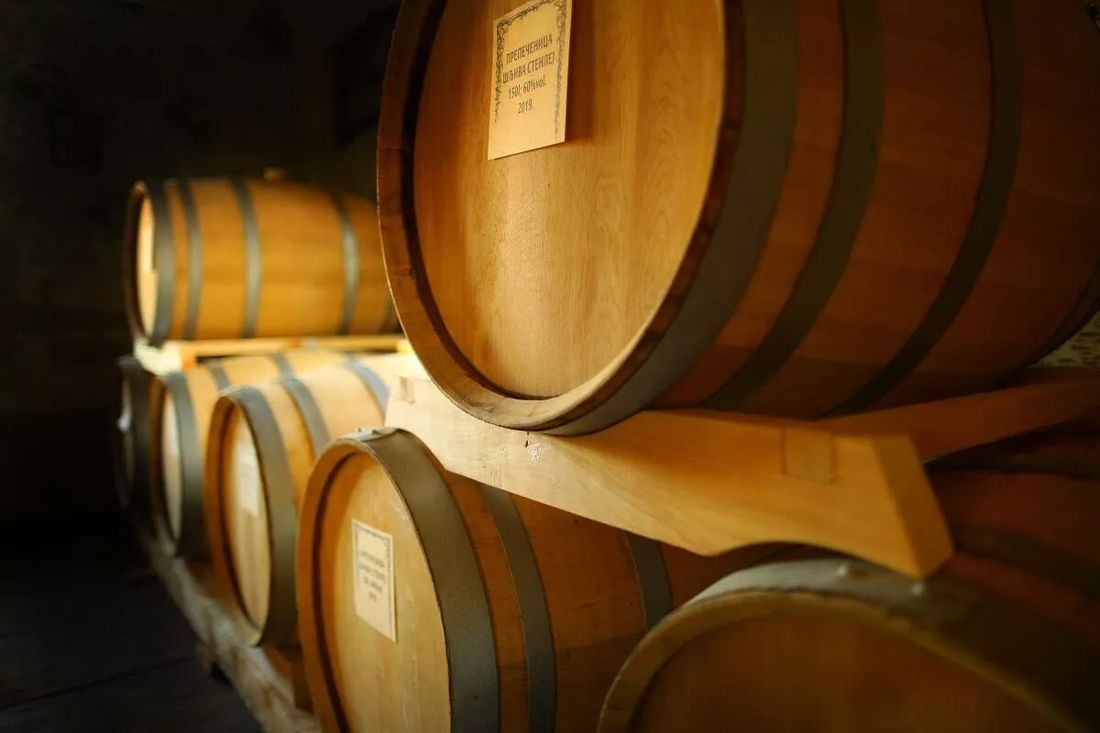
Wooden barrels are perhaps the best-known and most traditional way of keeping plum brandy. An oak barrel, particularly of pedunculate or sessile oak, gives the brandy its characteristic aromas and colour. It matters that the barrel is made from oak of the right age, because young wood can affect the flavour and give it an unwanted green note. In our own production we use only oak more than 100 years old, grown in a mountain climate. Barrels made from oak with those characteristics are excellent for maturing brandy. Barrels are usually conditioned with wine before the brandy goes in, which improves their ability to add complexity of flavour still further.
Brandy that is to be kept in a barrel should be at a strength of 43 to 45 per cent. Bear in mind that double-distilled brandy in a barrel can lose up to 0.7 per cent alcohol by volume over a year. The minimum a brandy should spend in a barrel is six months, and slivovitz is a spirit that can mature in a barrel for more than ten years. Cellar conditions should be 10 to 20 °C with humidity of 70 to 80 per cent.
The glass alternative: clean and simple
Glass vessels offer a clean, neutral space for keeping plum brandy. The method is popular for its transparency, which lets you watch the colour and clarity of the brandy as it is kept. Brandy kept in glass usually retains its natural character, without the additional aromas that wood would bring. It is important to make sure glass vessels are well sealed, so that no oxygen gets in and the freshness of the brandy is preserved.
Brandy stands in glass vessels for at least six months, so that the chemical processes stirred up by distillation can settle. Brandies of this kind are left at a strength of 40 to 43 per cent by volume.
Stainless steel and ceramic: practical options with different advantages
Stainless steel vessels are popular for their durability and the ease of keeping them clean. They offer a clean, stable space for the brandy and are often used as an alternative to wood or glass. Ceramic vessels also have their place in keeping plum brandy, offering insulation and stable temperature. Both are good options for anyone looking for practicality and reliability.
Oak chips where barrels are not available
Because good oak barrels are not always available, some producers choose oak chips or cubes to add characteristic aromas to the brandy. The method can be an effective substitute for a traditional barrel, though it should be borne in mind that the result may differ from brandy kept in wood. Adding oak chips or cubes to stainless steel, ceramic or glass vessels can give the brandy notes of vanilla and other complex aromas.
Why the right storage conditions matter
Whatever material you choose, it is important to ensure the right conditions for keeping plum brandy. The temperature and humidity of the room play a key part in preserving quality and stability over time. Ideal conditions are usually a temperature between 10 and 20 degrees Celsius, with air humidity between 70 and 80 per cent.
Storing plum brandy is an important step in production, and one that can markedly affect the final flavour and quality of the product. Choosing the right material and keeping the storage conditions right are the key factors in a first-rate result. Whether you settle on a traditional wooden barrel, glass, stainless steel or ceramic, it is worth approaching this step with care and with respect for tradition and quality.